Spatial Analysis Done Right
You want to do spatial statistics, and it’s going to involve binning.
Binning with a rectangular grid introduces messy distortions. At the macro-scale using a rectangular grid does things like making Greenland bigger than the United States and Antarctica the largest continent.
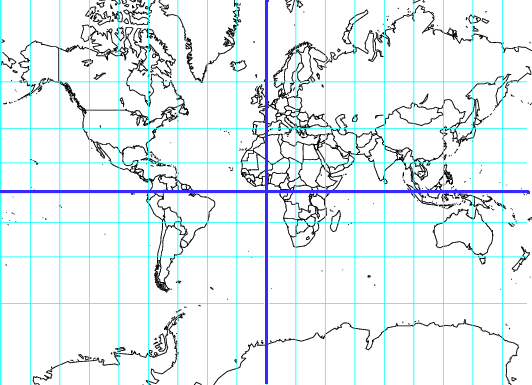
But this kind of distortion is present no matter what the resolution is; in fact, it shows up whenever you project a sphere onto a plane.
What you want are bins of equal size, regardless of where they are on the globe, regardless of their resolution.
dggridR solves this problem.
dggridR builds discrete global grids which partition the surface of the Earth into hexagonal, triangular, or diamond cells, all of which have the same size. (There are some minor caveats which are detailed in the vignettes.)
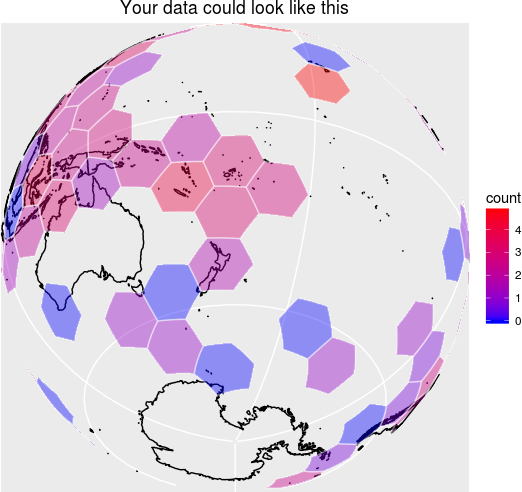
(Naturally, you can use much smaller cells than those shown in the image above.)
This package includes everything you need to make spatial binning great again.
Many details and examples are included in the vignette.
Installation
dggridR is available from CRAN via:
If you want your code to be as up-to-date as possible, you can install it using:
Show me some code
Okay.
Your analysis could be as easy as this:
library(dggridR)
library(collapse)

#Construct a global grid with cells approximately 1000 miles across
dggs          <- dgconstruct(spacing=1000, metric=FALSE, resround='down')

#Load included test data set
data(dgquakes)

#Get the corresponding grid cells for each earthquake epicenter (lat-long pair)
dgquakes$cell <- dgGEO_to_SEQNUM(dggs, dgquakes$lon, dgquakes$lat)$seqnum

#Get the number of earthquakes in each equally-sized cell
quakecounts <- dgquakes |> fcount(cell)But I want higher resolution grids than that
Many different grid resolutions are available for many different grids. The following chart shows the number of cells, their area, and statistics regarding the spacing of their center nodes for the ISEA3H grid type.
| Res | Number of Cells | Cell Area (km^2) | Min | Max | Mean | Std |
|---|---|---|---|---|---|---|
| 1 | 32 | 17,002,187.39080 | 4,156.18000 | 4,649.10000 | 4,320.49000 | 233.01400 |
| 2 | 92 | 5,667,395.79693 | 2,324.81000 | 2,692.72000 | 2,539.69000 | 139.33400 |
| 3 | 272 | 1,889,131.93231 | 1,363.56000 | 1,652.27000 | 1,480.02000 | 89.39030 |
| 4 | 812 | 629,710.64410 | 756.96100 | 914.27200 | 855.41900 | 52.14810 |
| 5 | 2,432 | 209,903.54803 | 453.74800 | 559.23900 | 494.95900 | 29.81910 |
| 6 | 7,292 | 69,967.84934 | 248.80400 | 310.69300 | 285.65200 | 17.84470 |
| 7 | 21,872 | 23,322.61645 | 151.22100 | 187.55000 | 165.05800 | 9.98178 |
| 8 | 65,612 | 7,774.20548 | 82.31100 | 104.47000 | 95.26360 | 6.00035 |
| 9 | 196,832 | 2,591.40183 | 50.40600 | 63.00970 | 55.02260 | 3.33072 |
| 10 | 590,492 | 863.80061 | 27.33230 | 35.01970 | 31.75960 | 2.00618 |
| 11 | 1,771,472 | 287.93354 | 16.80190 | 21.09020 | 18.34100 | 1.11045 |
| 12 | 5,314,412 | 95.97785 | 9.09368 | 11.70610 | 10.58710 | 0.66942 |
| 13 | 15,943,232 | 31.99262 | 5.60065 | 7.04462 | 6.11367 | 0.37016 |
| 14 | 47,829,692 | 10.66421 | 3.02847 | 3.90742 | 3.52911 | 0.22322 |
| 15 | 143,489,072 | 3.55473 | 1.86688 | 2.35058 | 2.03789 | 0.12339 |
| 16 | 430,467,212 | 1.18491 | 1.00904 | 1.30335 | 1.17638 | 0.07442 |
| 17 | 1,291,401,632 | 0.39497 | 0.62229 | 0.78391 | 0.67930 | 0.04113 |
| 18 | 3,874,204,892 | 0.13166 | 0.33628 | 0.43459 | 0.39213 | 0.02481 |
| 19 | 11,622,614,672 | 0.04389 | 0.20743 | 0.26137 | 0.22643 | 0.01371 |
| 20 | 34,867,844,012 | 0.01463 | 0.11208 | 0.14489 | 0.13071 | 0.00827 |
Credits
The src/ directory contains a vendored copy of DGGRID v9.0b by Kevin Sahr, maintained as a fork at SebKrantz/DGGRID.
Richard Barnes built the original R package and hand-written Rcpp bridge, including:
- Replacement of gpclib with clipper, making DGGRID fully FLOSS
- Restructuring of makefiles and include paths to enable compilation in R
- Direct inclusion of the shapelib library
- Addition of the SEQTOPOLY option under the GENERATE_GRID faculty
- Fixes for GCC 6, ISO C conformance, and -Wall/-pedantic warnings
Sebastian Krantz has made the following additions (v3.1.0 onward):
- Updated the bundled DGGRID engine from v7 to v9.0b and re-architected the Rcpp bridge
- Fixed numeric precision issues on Apple Silicon
- Replaced dplyr/rlang/sp with collapse and sf; cell polygons are assembled in C and converted with
sf::st_as_sfc(), yielding significant performance gains - Added aperture-7 grids (ISEA7H, FULLER7H) and mixed-aperture grids (ISEA43H, FULLER43H)
- Added
dgneighbors(),dgchildren(),dgparent()for cell-relationship queries - Added
dgpoints_to_cells()anddgbin_points()for point aggregation - Added
densifyparameter to grid-materialization functions - Added
orient = "RANDOM"todgconstruct()for random icosahedral orientation
The package relies on several bundled libraries, as noted in the Licensing section below.
Licensing
This package is released under the GNU Affero General Public License v3 or later (AGPL ≥ 3), as stated in LICENSE.md.
The following bundled libraries in src/ have their own licenses:
- clipper: Boost Software License v1.0 (Angus Johnson)
- dggrid: Released as public domain software by Kevin Sahr
- proj4lib: Released into the public domain by Gerald Evenden
- shapelib: MIT-style license (Frank Warmerdam)
Disclaimer
This package should operate in the manner described here, in the package’s main documentation, and in Kevin Sahr’s dggrid documentation. Unfortunately, none of us are paid enough to make absolutely, doggone certain that that’s the case. That said, if you find bugs or are seeking enhancements, we want to hear about them.
Citing this Package
Please cite this package as:
Richard Barnes, Kevin Sahr, and Sebastian Krantz (2026). dggridR: Discrete Global Grids for R. R package version 4.1.0. https://sebkrantz.github.io/dggridR/ doi:10.5281/zenodo.1322866